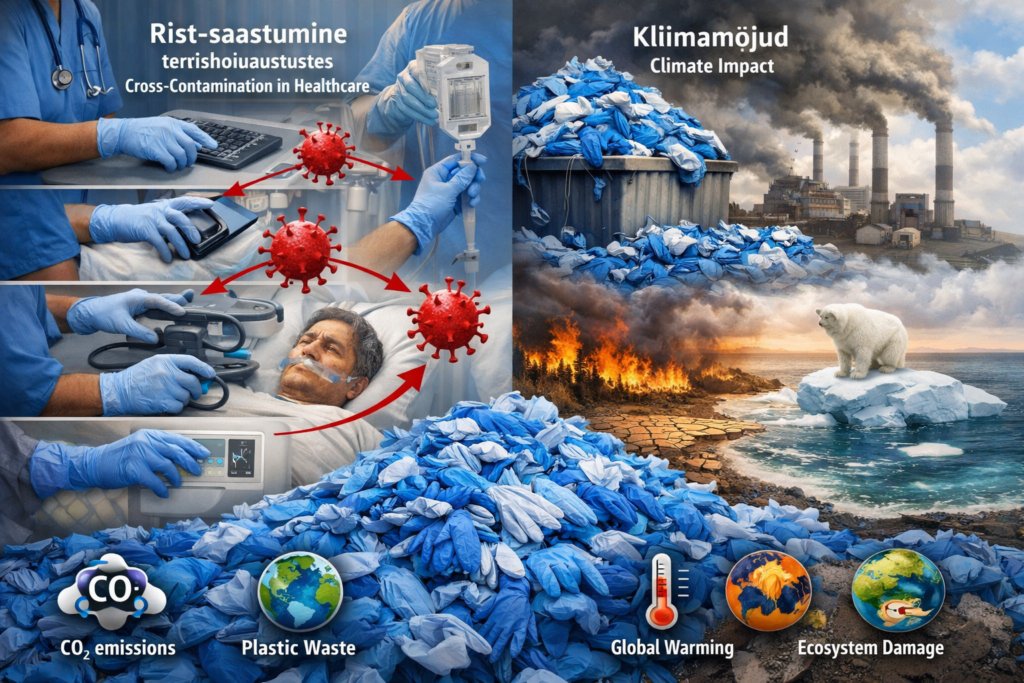
Glove overusage

Glove Use in Healthcare
IPC · MODULE 1 OF 3 Glove Use in Healthcare
You wear gloves to protect patients and yourself.
You know gloves are a key part of standard precautions.
You want to do the best possible job for your patients.
🧤🧤🧤🧤🧤🧤🧤🧤🧤🧤🧤🧤🧤🧤🧤🧤🧤🧤🧤🧤
40%
of glove use in healthcare is unnecessary or incorrect

The glove problem is real.

Healthcare generates an estimated 8 million tonnes of waste annually — and gloves are a major contributor. Most of this ends up in clinical waste streams that require energy-intensive incineration.

⚠️ Overusing gloves does NOT mean better protection. Worn incorrectly, gloves become a vehicle for cross-contamination — transferring pathogens between surfaces, patients, and environments.

A glove-covered hand that touches a contaminated surface and then a patient is just as dangerous as a bare hand doing the same.

IPC · MODULE 2 OF 3 WHO Glove Use Pyramid

When are gloves actually needed?

The WHO Glove Use Pyramid ranks indications from most to least justified. Tap each level to learn more.

↑ GLOVES INDICATED      NOT INDICATED ↓
Sterile procedures (surgery, IV insertion)
Always wear gloves for any invasive procedure: surgery, central line insertion, urinary catheterisation, preparing chemotherapy. These require sterile gloves.
Blood / body fluid exposure risk
Wear gloves when significant exposure to blood, body fluids, secretions or excretions is anticipated. Change gloves between patients.
Non-intact skin or mucous membranes
Gloves indicated if you may touch a patient’s open wound, mucous membranes, or if you yourself have skin breaks or dermatitis.
Epidemic/emergency situations
Situational. During outbreaks (e.g. Ebola, COVID-19), additional PPE guidance may apply. Follow local protocols — do not generalise beyond official guidance.
Touching intact skin / environment
⚠️ Gloves usually NOT needed for touching a patient’s intact skin or routine environmental surfaces. Hand hygiene is sufficient — and more effective.
No contact / administrative tasks
🚫 Never indicated. Writing notes, using a phone, pushing a trolley, greeting a patient — wearing gloves here is wasteful and creates a false sense of security.

TAP A LEVEL TO EXPAND

💡 Remember the Rule of Three: Wrong indication. Wrong technique. Wrong removal. Any one of these turns gloves into a hazard, not a protection.

IPC · QUIZ Quick Check
QUESTION 1 / 3 Score: 0

A nurse is about to take a patient’s blood pressure on intact skin. Should she put on gloves?

SELECT THE BEST ANSWER

COMPLETE Glove Awareness Training
🎉 ⭐ 🧤 ⭐ 🎉
🏆

GLOVE GUARDIAN

CERTIFIED · IPC AWARE

0/3 CORRECT ANSWERS

“Gloves protect — but only when used right.
Your hands are still your most powerful IPC tool.”

🔑 Your 3 Key Takeaways

Gloves are not a substitute for hand hygiene — they work together.
Wrong indication, wrong technique, or wrong removal all create cross-contamination risk.
Use the WHO Glove Pyramid: if in doubt, ask yourself — is there a genuine exposure risk?

Completed · Glove Use Awareness · IPC Training Series